
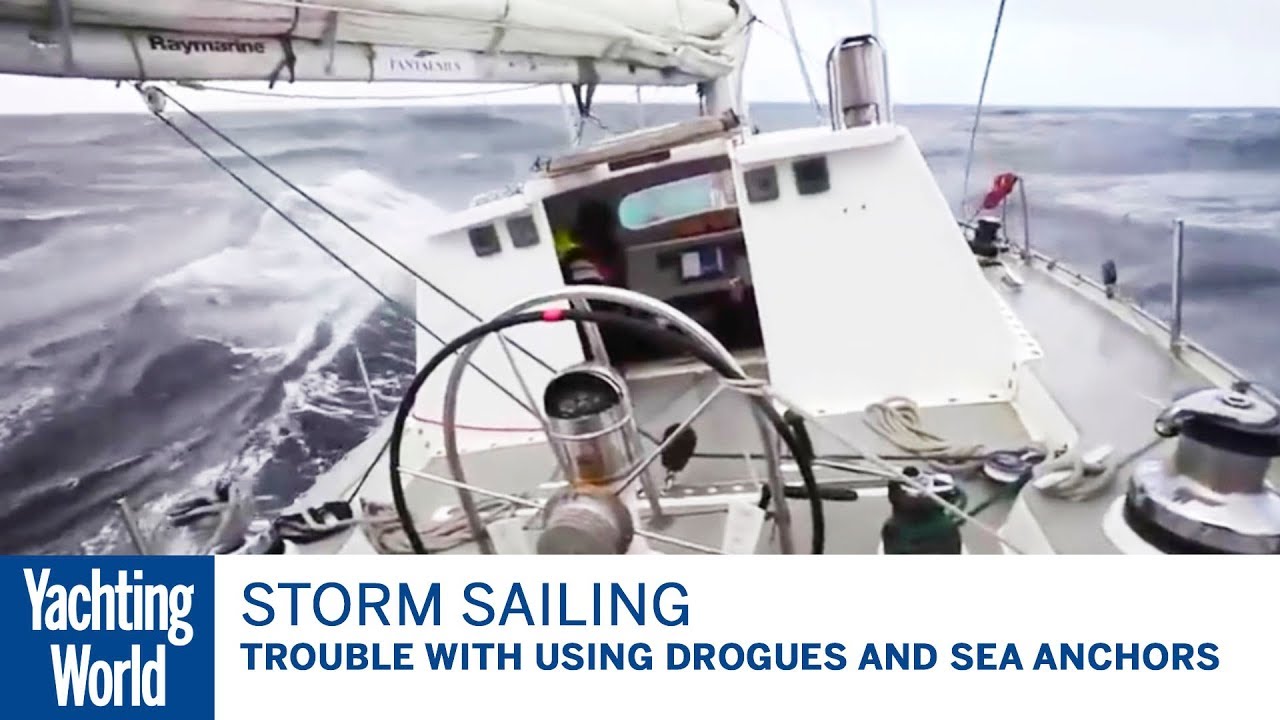
În acest videoclip, guru al expediției Skip Novak abordează eficiența warps-urilor și angajamentelor atunci când vine vorba de spargerea mărilor într-o furtună www.yachtingworld.com/storm-sailing-techniques ► Deveniți un ABONAT GRATUIT la pagina YouTube a Yachting World acum – https:/ /www.youtube.com/user/yachtingworld?sub_confirmation=1 ► Pentru cele mai recente recenzii, lansări de echipamente noi și știri despre tur, vizitați site-ul nostru aici – http://www.yachtingworld.com ► Dă Like-ne pe Facebook aici – https: //www.facebook.com/yachtingworldmagazine ►Urmăriți-ne pe Twitter aici – https://twitter.com/yachtingworld ►Nu ezitați să comentați mai jos! ►Nu uitați să apăsați butonul de LIKE dacă v-a plăcut 🙂
source
Problema cu folosirea ancorelor și a ancorelor maritime – Skip Novak’s Storm Sailing | Lumea Yachtingului
39 thoughts on “Problema cu folosirea ancorelor și a ancorelor maritime – Skip Novak’s Storm Sailing | Lumea Yachtingului”
Comments are closed.











20 years ago I used an improvised drogue in an heavy storm in the Atlantic in a light catamaran… it gave us a few nights of rest and reduced the drifting between us and Cap Blanc that was only 200 miles downwind… after 3 days those 200 miles where 70 only but at the right angle to get refuge in Jorf Lasfar industrial harbour without kissing the African coast.
That "drogue" has been priceless and I would have loved to have a real one along…
As always… "It depends"
It fails to describe the equipment and tactics. It assumes that you already know what warps and drogues are,
Are you saying "stream warps over the side?" I know what a drogue is but haven't heard of this other thing you speak of.
I just read through many of the comments and until now I had though sailors were a little less snarky than other internet trolls. You folks can choose to differ your opinions but the sniping is unattractive.
Excellent sailor but they guy has never used the gear and he's being asked to speculate about the process.
Sadly this is a very old video. Let's hope there are still some viewers interested in discussing the topic. My view as an armchair sailor:
I understand his perspective when it comes to heavy monohulls with lots of keel ballast and a low COG. But that's beyond the point, because those are also the vessels with a higher dynamic stability, anyways. They mainly have to worry about excessive structural loads, but can heave to without a serious capsize risk. It's the opposite situation for light catamarans and light monohulls: structural loads are less of an issue, but wind and waves will flip them over more easily. A low freeboard and/or vulnerable aft deck (large glass doors on catamarans) can be of additional concern.
The bow by design can absorb waves better than the stern (not to mention breaking waves flooding the aft deck / cockpit), therefore intuitively it sounds smarter to point the bow into the waves instead of running off the waves, even with a speed-limiting drogue deployed from the stern. On the other hand, with a para-anchor deployed from the bow, there is the risk that the line will go slack in the worst moment and the boat will yaw (and potentially capsize) or even trip over the stern the exact moment when a big wave with a steep surface (/breaking wave) hits. It seems like the Jordan Series Drogue, i.e. a device deployed from the stern for a different purpose, resolves the issue of the line going slack (+ weight also seems to help keeping the line under tension and the device submerged below the main wave action).
Hence the question: why not combine the two approaches into a "series parachute" deployed from the bow, i.e. ~8-10 smaller parachutes (e.g. ~ 0.6-1.0 m diameter, depending on boat weight) distributed over a 100-150 m line, with a weight at the end and a trip-line for easier retrieval?
It doesn't make sense to me that we're either talking about huge single devices (parachutes) or, at the other extreme, very tiny series devices (Jordan Drogue). Why is there nothing in between, i.e. no medium sized drag-creating devices in series, for the same purpose as a para-anchor, i.e. a passive storm-tactic device to more or less hold the boat's position, but without the main disadvantage of parachutes, i.e. the abrupt changes between going slack and being under extreme loads? Even commercially available "single" drogues could be combined into a series for an easy DIY device. I don't see no reason why such a "series parachute" isn't the best of both worlds.
Why not a standard Jordan Drogue atypically deployed from the bow, with the bow pointing into the waves? Just like a standard para-anchor, it might not at all times create enough tension holding the bow back in order to reliably prevent the boat from yawing or tripping over the stern. With the Jordan Drogue I see the problem that the individual cones are so close to each other that each cone is in the shadow of the wake of the next cone in front (the wake has a greater diameter than the cones), like a line of trucks driving in the wind shadow. Therefore a really effective Jordan Drogue would need to be prohibitively long. For a fixed overall length – correct me if I'm wrong – I believe we can achieve more total drag with fewer bigger cones / parachutes (whilst using the same amount of material), because I don't think that the relationship between modifications in cone distance & size and total drag is linear.
Thoughts anybody?
[this is view as a private person; I have no affiliation to any of the companies in the drogue / sea-anchor business]
All due respect to Skip, they interview a fellow who never uses a sea anchor to talk about deploying them? Seriously…
Skip's professional comment…"i've never done it before…" therefore I don't really know what I'm talking about. If it's too hazardous and too rough to deploy a drogue, then it's definitely too risky to turn the damn thing around and Hove-to, risking the worst thing…the next big wave rolling you over. The comment "nightmare of deploying it" is proof he does not know what he is talking about.
Oh okay, no need to consider these options since Skip Novak has never needed to use them. Gosh that's a relief. Thanks Yacht World you're the best. 😂
Perhaps this video was best left in the camera.
Even if I am heaved too I still need to deploy a drogue so you don't go surfing down big waves and broaching then be broadside.
Skip Novak is what I thought I looked like when I was in the Sea Scouts. In reality I was lucky not to ground the ship on the Dana Point Harbor jetty.
Thanks for talking about them
Might keep looking for people
who have used them successfully
(lived to tell, even if went badly)
In short; know your boat!
I have seen that you can use a drogue to steer should all other methods of steerage fail. Seems like a handy piece of equipment to have on board during an ocean passage.
Anchor point seems to be the critical link in this chain, if you're pulling against a raging Sea, something is likely to fail and catastrophicly.
I would think this system is best utilized for crew breaks in mild to moderate seas?
To me, the problem with employing a drogue or sea anchor aft in heavy seas when choosing to run with them is that wave frequencies are never constant and setting the drogue to leave you ever sailing down the crest of a wave is difficult. Sooner or later (and it'll be sooner, at night) you'll crash down into a trough or get pooped, and in huge seas, that's a problem. Lin and Larry Pardey had success heaving to with a sea anchor off the bow. Most of the time, heaving to should be our go-to, followed by bare poles imho.
Tried to deploy the Para anchor once revolvkng storm off bermuda). Couldn't but banged me knee enough that they wanted to removed self from boat quote-yer gunna die mate. Obviously I'm writing this sooooo…. Not dead
Skip makes very good points about load factors and the danger of handling gear on a large, heavy boat in severe conditions. What makes perfect sense on his boats in his waters may be different on a smaller boat, a Contessa 32 perhaps, in an open-ocean storm. I suppose a good seaman is one who can adapt to the situation, the boat, the skill level of the crew, the equipment available…
So the more I watch videos from thus channel the more I f8nd good and bad. Good because I definitely learn a lot, but bad because things are taken in a very narrow scope or not as much stuff is shown that I think should be. For example in relation to this video, 99% of sailors I've seen anticipate the potential for a bad storm and deploy drouges or sea anchors early before it becomes too dangerous to do so, or they are knowingly and purposely sailing into a dangerous storm and are prepared for how to handle it before they do. This video was obviously aimed at those who DON'T have the ability to be prepared beforehand, so maybe more time should been spent explaining the uses and the safe way to deploy them for peo0le who don't know, or alternative actions. Heaving to is not possible on some boats, and it can be nearly impossible 9n may boats if the storm is bad enough, so maybe talk more about h9w to deal with that if you d9nt think the other options are good. All I learned from this video is you're too smart to get caught in a storm bad enough to need them, or too stubborn to use them if you do. Zim the video at people this doesn't apply to I think.
I would also add that in my tiny experience heaving to off the bow may slow the boat down better than a series drogue or trailing warps. If sea room is an issue i would go off the bow. Also running before a storm keeps you in it longer methinks.
True sailors are right here , good commentary. The best of the best.
Better hold fast . ARRRRRRRRrrr
Let's talk apples and apples jorden series drogue ? after watching Skip I practiced my hove to and i'm seriously thinking about four reefs But I really do wanna hear more information on the JSD
Heaving to? Really? Why not deploy a drogue and go with it? I don't understand this video. Skip has never used one but asserts that it should not be used. Why not have someone who uses drogues talk about its deployment, when, and why?
I have taught the use of drogues and deployed them many times, i.e., anchors, warps, drogues, series drogues, etc. And have used them in real situations too. I fail to see why one would prefer to heave-to (under trisail, I reckon) when you could reduce the forces of apparent wind and sea state by passively or actively moving in that same direction.
In fact, I'd go further to say that a deployed drogue (active steering) is a great method for reducing yaw and improving stability. And it could be used in normal (non-storm) situations when running down sea, especially at night.
So interesting to listen to such an experienced sailor. Thanks for a great instructional video.
Why even post this video? This guy is totally out of touch. Sail a sub 30' boat across an ocean and then you'll have some authority on the subject.
looking at series drogues, i always see these "recipes" ( weight, length of rode, and number of chutes ), and some people refer to series drogues as "stopping drogues"..
but why couldn't you make a series drogue differently ? Or, use the same one differently, ( depending on the weight you attach, and how many chutes you let out ) ???
even heaving to… i think i would be better to have a tune-able brake …. though the series format seems the most flexible, it is yet the most stringent as to construction and use, why???
like he said, heaving to …. but what would be wrong with also carrying a series drogue 1/2 to a 1/3 the recommended, and two or three different lighter weights to put on the end ???
depends on the boat. Without something to hold the water….in a small boat you are fucked
For large displacement “fuller keel” boats H-Too yeah but for those of us on smaller lighter boats a Para-Anchor makes sense.
Look at some very small boat voyages like Robert Manry “13’ Tinkerbelle he sailed Massachusetts to England and deployed his canvas bucket sea anchor over a dozen times to ride out a gale.
A sea anchor can stabilize the boat if something breaks or a single hand can get some rest.
I just got a 6’ Fiorentino Para anchor and will do some testing in the next coming weeks (17’ Lyle Hess designed sloop”
May be worth carrying a Galerider style drogue for emergency steering, in the event of rudder failure, if not for heavy weather.
As for sea anchors Lin and Larry Pardey found them to be the best heavy weather option, employed with a line run back to a primary winch from a snatch block on the rode to control the vessel's angle to weather. I've never tried the technique but presumably one could deploy the rig without dangerous or damaging loads by first heaving-to.
Skip’s advice re storm tactics: go sailing in a 77 foot, 50 ton boat 😅😁 …thanks!
So surprised to hear Skip suggest lying ahull. That is something I would never consider. Our bridal is mounted at the stern and ready to go on long passages (secured with breakaway zipties for fair deployment), so launching our series drogue isn't as problem.
mm he makes so much sense..
Yet the ARC now insists on you carrying a drogue…
Heaving to really is a simple option if the particular boat at play holds well,
and the bow doesn't drift too far down to expose the boat dangerously to abeam waves and wind. In that case the hassle of the sea anchor and practiced drills will prove worthy to keep the bow up.
As for streaming warps to slow the boat and thus control it better when running with a storm and waves it will depend on crew skill and energy if it's good to deploy. And anyway is only done when destination is downwind and safe enough to still steer. Otherwise forereaching is the way in storms to put the boat with bow into elements as it's designed to do. Or if crew fatigue drops more to heave to as the leeward drift will feather waves. Not like lying ahull which is only safe in smaller wave conditions.
Some will. Some won't. Guess it's up to the skip-per.
When more skip novak videos?
Moitessier never used a drogue. What's that tell you? I mean this guy sailed around the horn a coupla times in some of the biggest seas imaginable. I also knew someone that made the same trip and he did not use a drogue either. These were both double-enders that do NOT handle a following sea very well. however they were also mid ship cockpit steel, deep keeled boats as well. My good friend's though was a bit shorter than the Joshua (but what a boat that was I mean it plowed through a 15 foot sea like it was nothing). He got caught in Hurricane Donna in 60 as a Cat 4 because it was so humongous that he couldn't outrun it. I can't even imagine that myself. Said he didn't sleep a wink in 3 days. Not me.
Trip line for retrieval! Of course you will only be doing this once the weather abates, if you can’t come around and grapple a line with a float on it you shouldn’t be on the water! Sure things are a risk factor as boating goes, but knowledge and experience should see the day out.