
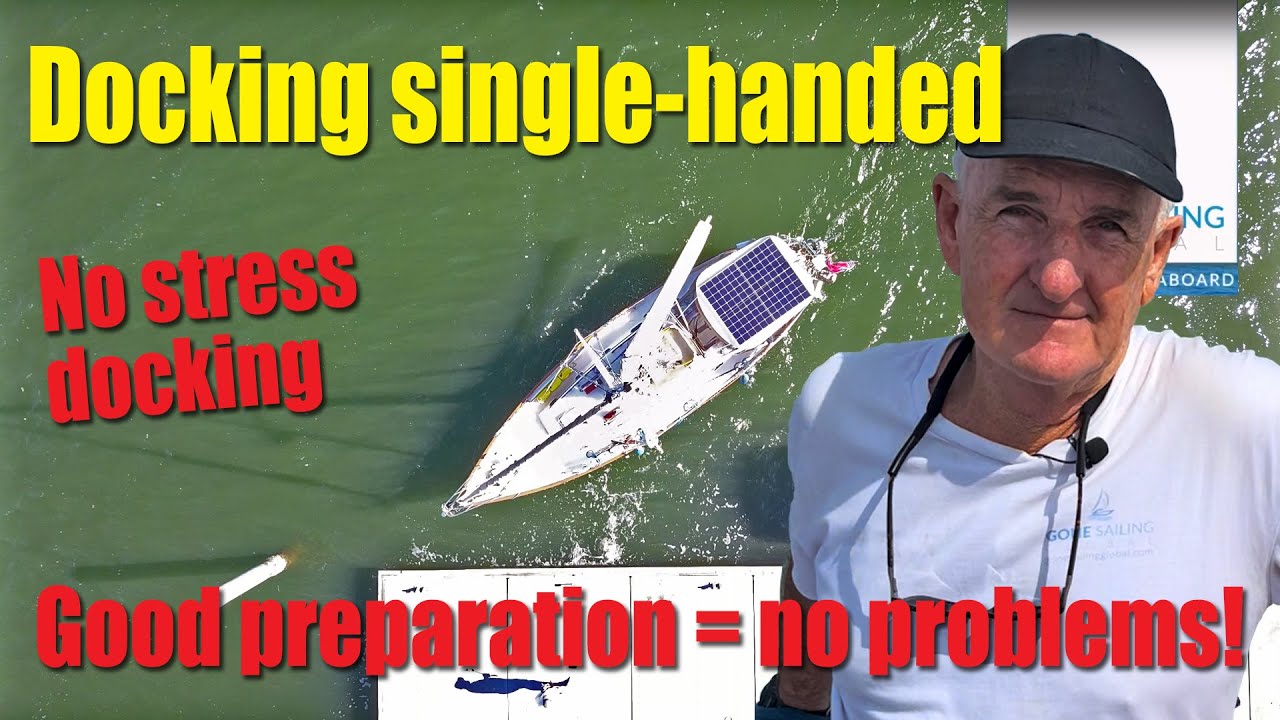
În acest episod Pete, un yachtie foarte experimentat, care a trăit pe barca sa de zeci de ani, ne arată cum își aduce barca în doc. Dacă sunteți nou la andocare, faceți încet, în siguranță și în siguranță! La ce trebuie să mă gândesc înainte de a -mi muta barca? Cum îmi leg barca? Învață să înțelegi influențele vântului și curentului atunci când îți atrii barca. Vino și alătură -te învață să trăiești la bord, suntem aici pentru a te ajuta! Scopul nostru principal este de a vă ajuta să înțelegeți mai bine lumea uneori descurajantă a bordului de bord. Cu videoclipuri informative, un portal de învățare online, forumuri și chat -uri pentru membri, link -uri utile și o legătură directă cu echipa – sunteți sigur că vă veți urmări rapid învățarea într -o viață mai bună, mai sigură și mai plăcută la bordul unei bărci. Suntem o echipă de oameni cu experiență în viață, la bord, al căror scop este de a -i ajuta pe ceilalți să treacă mai lin în acest stil de viață uimitor și plin de satisfacții. Alătură -te acum. Pune întrebări. Implică -te. Intrați mai devreme pe apă. Vizitați -ne la: www.learntoliveaboard.com.au Învață să trăiești la bord.
source
Cum să duci o singură mână? | Docking cu o singură mână – EP10
31 thoughts on “Cum să duci o singură mână? | Docking cu o singură mână – EP10”
Comments are closed.











A couple of questions. First, with the breeze blowing on to the dock then why not dock starboard to so that you have the benefit of prop walk for departure. Second you discuss springing off the dock but don’t demonstrate it and instead simply push the boat off, why?
What a beautiful boat..
Westsail 32?
Sorry maid, the most stupid explanation for the direction of prop walk.😂
First of all, a turning device push the water jet in every direction, like a circle, not only left or right. My 5 years old daughter know this. It doesn't matter if anti- or clockwise.
However, if the water jet encounters a resistance (boat hull) , the water pressure increases in front of this resistance. The resistance (boat hull) is pushed away by the higher water pressure. That's why the boat hull moves to the side.
That means we have a prop walk in forward gear and in reverse.
Although , the prop push the water much more effective to the front (keel) or back (rudder). Thats why its very efficient to steer in forward gear and normally the prop walk in forward gear isn't a problem.
You're being unnecessarily rude and can't spell "mate".
Pete’s boat looks like a PS—a 37’? No fair using this guy as an example. That is one on the hardest boats to maneuver in a Marina and he does it with too much accuracy and finesse. He knows his boat well. Bravo!
In the come island world. , we throw the eye onto the dock cleats and make off on the boat. Nice job thou.qw
I find it very cavalier of you to jump on the dock without a line holding you to the dock and unreasonable that you board without a line on the dock which can be released once you are under way.
Without Prejudice
Your "Practical" approach enables understanding.
It would appear one or two people want to go into argument, while A Captain Of a Yacht is looking out for Yacht Safety leaving the Dock, which he Obviously has prior experience, and, ease of Action in the circumstances encountered on the Day.
The Old Keep it simple stupid , otherwise known as K.I.S.S. is essential for beginners, while keeping in Mind, Build Overall Understanding!
As a result of reading comments , i have a Picture in my Mind of one commentator arguing wind direction, with the Wind, EnDangering his FAMILY, Yacht , and , CREW. It is NOT funny.
When laying out lines ready for deployment I like to be able to see the tail ends hanging inside.
great advice for beginners.
common!!
Very nice explanation. One tiny suggestion (i know, the best seaman aren't on the boat lol😂): you're showing how to tie on a cleat. The final hitches are better done reverse, such that the lines run parallel. It makes for a smaller knot, it unties more easily, it won't come loose, and you only need one of them (if it's unclear what I'm saying, on YT, search for "cleat hitch", there are some excellent vids).
Alternatively, run the lines back to the boat, in many cases that makes for an easier departure.
https://www.youtube.com/shorts/LsVUJWD_5bk
Now, THIS guy has it right !
btw. I NEVER get off the boat with no lines tied. Watching from the dock while my boat drifts away is bad enough. But in a crowed marina. Ugh!
Tks mate for the video. However, jumping of a boat which is still in motion seems not a good idea to me…. But nobody is perfect. Cheers!
Have you neglected those that have a long keel ?
The cleat thing is totally wrong so going off the boat without a line..
The rest I think it’s a good explanation
why speed up the docking video? literally the most important part lol
Fenders left in the locker are not helping protect the boat. Why only two fenders? In that situation I’d have all on the port side.
I fully agree with the comment made by @Misteribel
try with boat next to your docking and not in open water
Very good explanation of propwalk. Fair winds ~~~~_/) ~~~~~
This guy doesn't know how to do the knot, ahhh… English spagetti! :-)))))
Super helpful, mates. 🤙🏽 Cheers!
he comes into the dock and places his boat nicely ahead of the boat to his stern – then he ties up and there is no boat (or dock for that matter) to his stern!
kind of a mess tying onto those dock cleats. It should be less turns and much more simple. I'd show you a video but I'm in the comment section. Sorry to be so picky, but I work part time as an assistant harbormaster, and I'm always amazed at the variety and complexity of the docking tie ups.
Nothing good in this demonstration starting with getting off the boat without a line in hand.
Your audio sucks
Wrap those cleats about fifty more times. 🤡🤦♂️ Jeezus, people love to over wrap a cleat, ffs.
Good video, but only an expert should approach a dock that fast. Kind of showing off for a training video. Don't go any faster than you're prepared to hit something.
This is a great video showing how NOT to dock single-handedly. Here are a few critical observations:
1. Approach Speed: The speed of approach was far too fast for safe docking. A slower and more controlled approach would give you more time to react and adjust.
2. Fender Placement: The rear fender was adjusted to a better position at the last minute (!). However, it was squeezed excessively due to the speed of the approach, which can damage the hull over time.
3. Insufficient Fender Coverage: At 07:47, it’s evident that with the boat’s speed and the poor placement of the fender, there was only 5 cm clearance between the hull and the pier, just 0.5 m behind the fender. With one fender missing on the far stern part of the port side, a sudden gust of wind could have caused the hull to hit the pier. A fender should have been placed on the far stern section for better protection.
4. Bow Protection: The high speed caused a rush to protect the bow from hitting the mooring pylon. A slower approach would have reduced this risk.
5. Cleat Hitch Knot at 08:10: The cleat hitch knot was incomplete, which could cause it to loosen by itself. This is a critical mistake in securing the boat.
6. Knot Error at 08:38: The cleat hitch knot was finished incorrectly, with the final loop turned the wrong way, compromising its hold.
7. Knot at 09:04: A proper cleat hitch knot should have been used here. It’s secure even in stormy conditions. If in doubt, you could add an extra figure-eight loop before finishing.
8. Pushing the Keelboat at 11:20: Pushing a keelboat by hand in strong winds should be avoided. This is unsafe and unnecessary with proper technique.
9. Suggestions for Single-Handed Undocking at 11:20:
a) Keep the bow spring line but convert the cleat hitch knot to a slip line. From the boat, use slow ahead to release the spring line gradually, maintaining control, and then retrieve it.
b) Use a stern line only, also as a slip line. Considering the wind, the fenders should suffice. Again, use slow ahead to loosen and retrieve the stern line safely.
c) Alternatively, for these wind conditions, use the stern line as in option (b), but immediately gather it after engaging slow ahead. Never leave the boat entirely disconnected from the dock in such windy conditions.
10. Final Note: At 08:05, you mentioned this docking maneuver was a “10 out of 10.” In Scandinavia and most European countries, this would fail a skipper’s exam due to the safety oversights and improper techniques highlighted above.